Every new city and product, learning at the speed of your best launch.
Plavista Launcher is for food brands launching new products, line extensions and new cities. It plans each launch from your most similar past launches, then re-plans it from what actually sold, came back or sat in the channel, so it settles sooner with fewer returns and fewer empty shelves. It sits on top of the planning you already run and hands each line back once its launch is over.
Mature markets run on history. New ones run on guesses.
Returns land on your books
A brand that delivers direct to stores takes back whatever does not sell. In an established market, years of store history keep that low. In a new city, or for a new product, there is no history, so the first weeks of dispatch are a guess, and the guess comes back as returns.
Early sales can mislead
A sold-out shelf looks like weak demand, and stock filling a distributor's godown looks like strong demand. Either way, the first weeks of a launch are read wrongly, and a good product gets cut or a weak one kept.
Every launch learns from scratch
Each launch works out, store by store, what the last one already learned: which outlets sell, how fast demand builds, when to thin a route. That learning is paid for in waste and in shelves left empty, launch after launch.
The decision to scale is made on feel
Whether to add outlets, hold, change the range or pull back is often decided in a meeting without a benchmark. The money spent on the launch and what it earned back are rarely on the same page.
Four screens that follow a launch from plan to post-mortem.
Launch Library
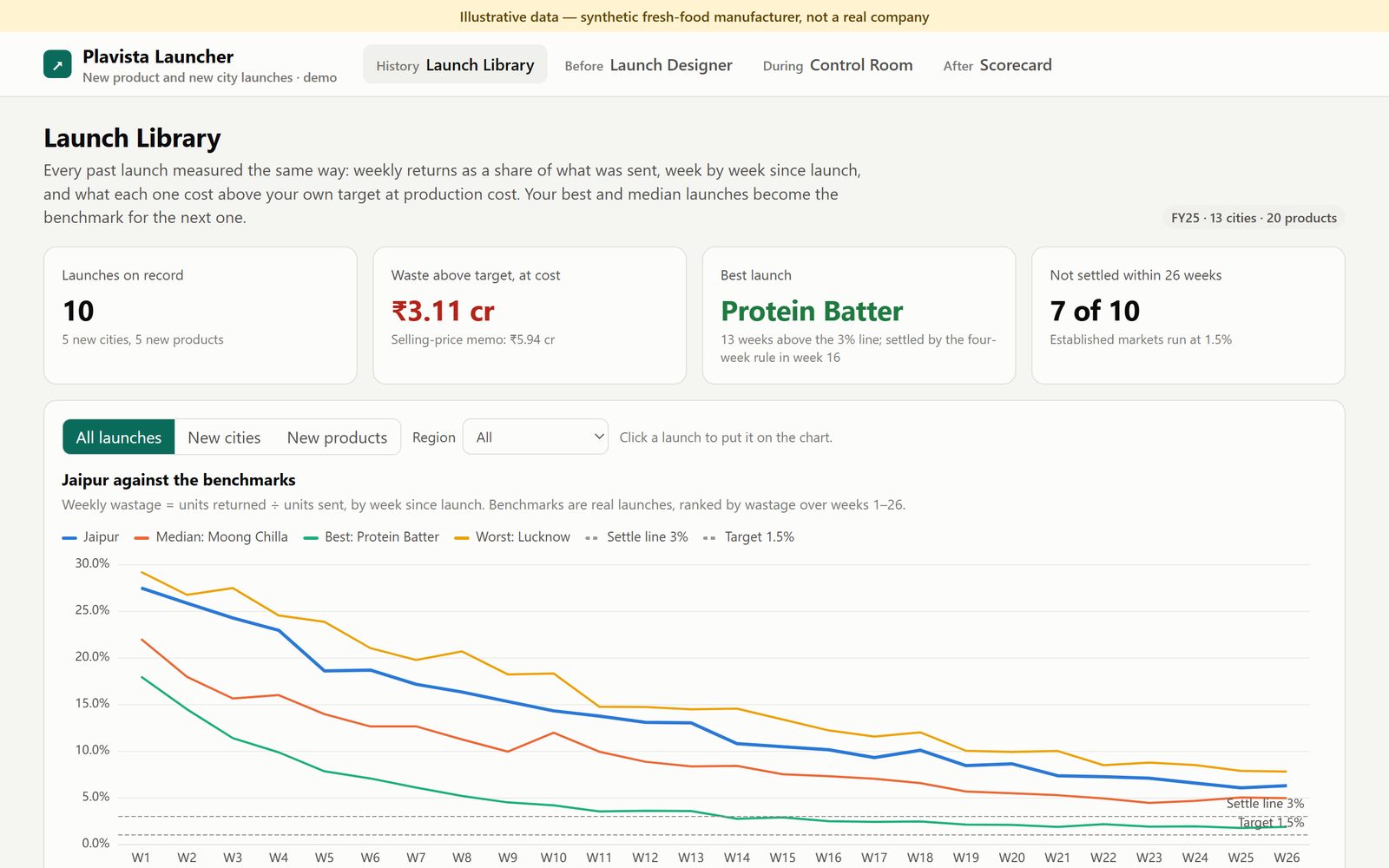
Every past city and product launch as a weekly curve and a cost: how fast it settled, what it wasted above your own target, at production cost. Your best and median launches become the benchmark.
Launch Designer
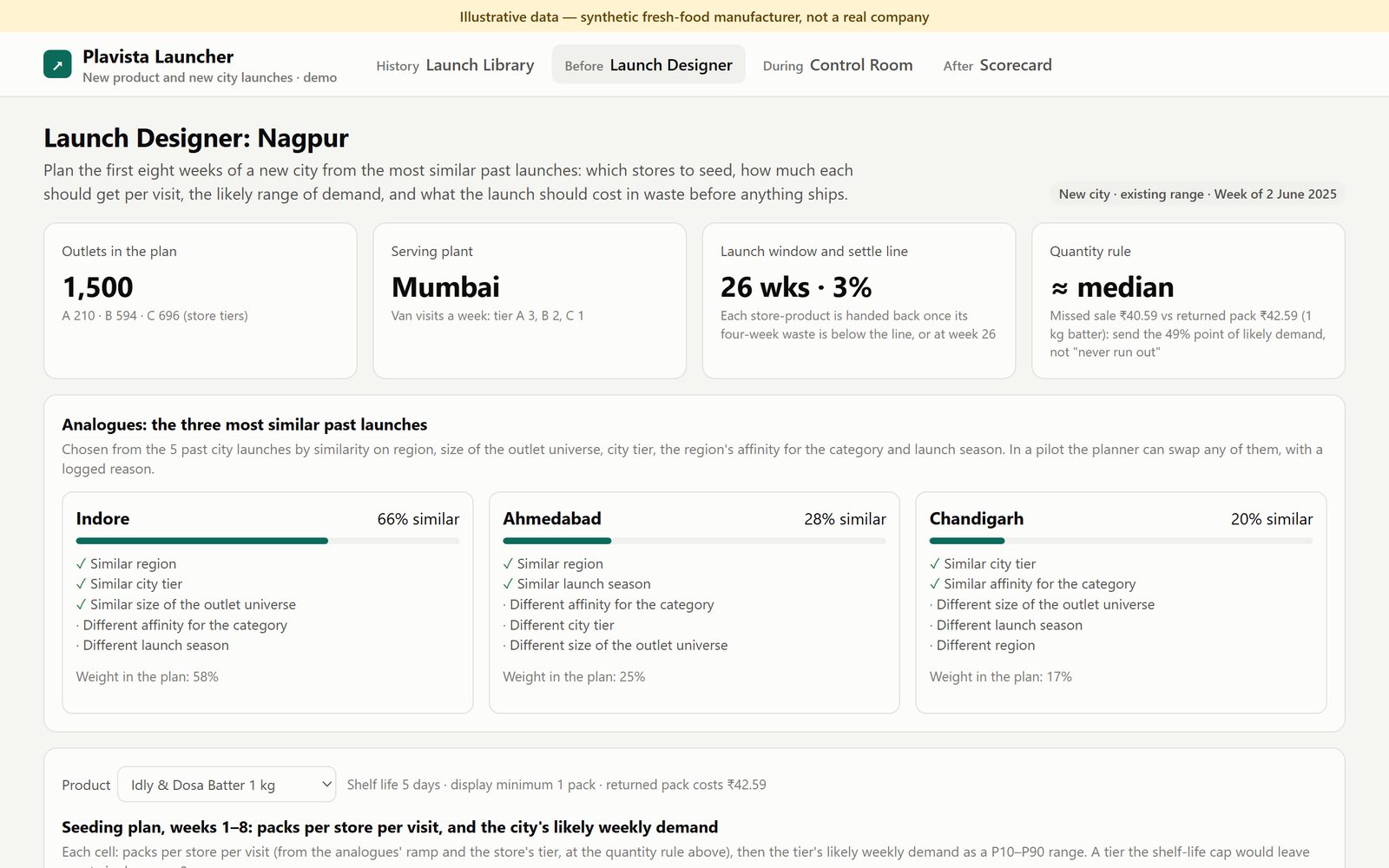
The three most similar past launches, with the reasons. A seeding plan by store tier and week with likely ranges, not single numbers. Seeding every tier against concentrating, as waste against reach. A business case with the week the launch should break even.
Control Room
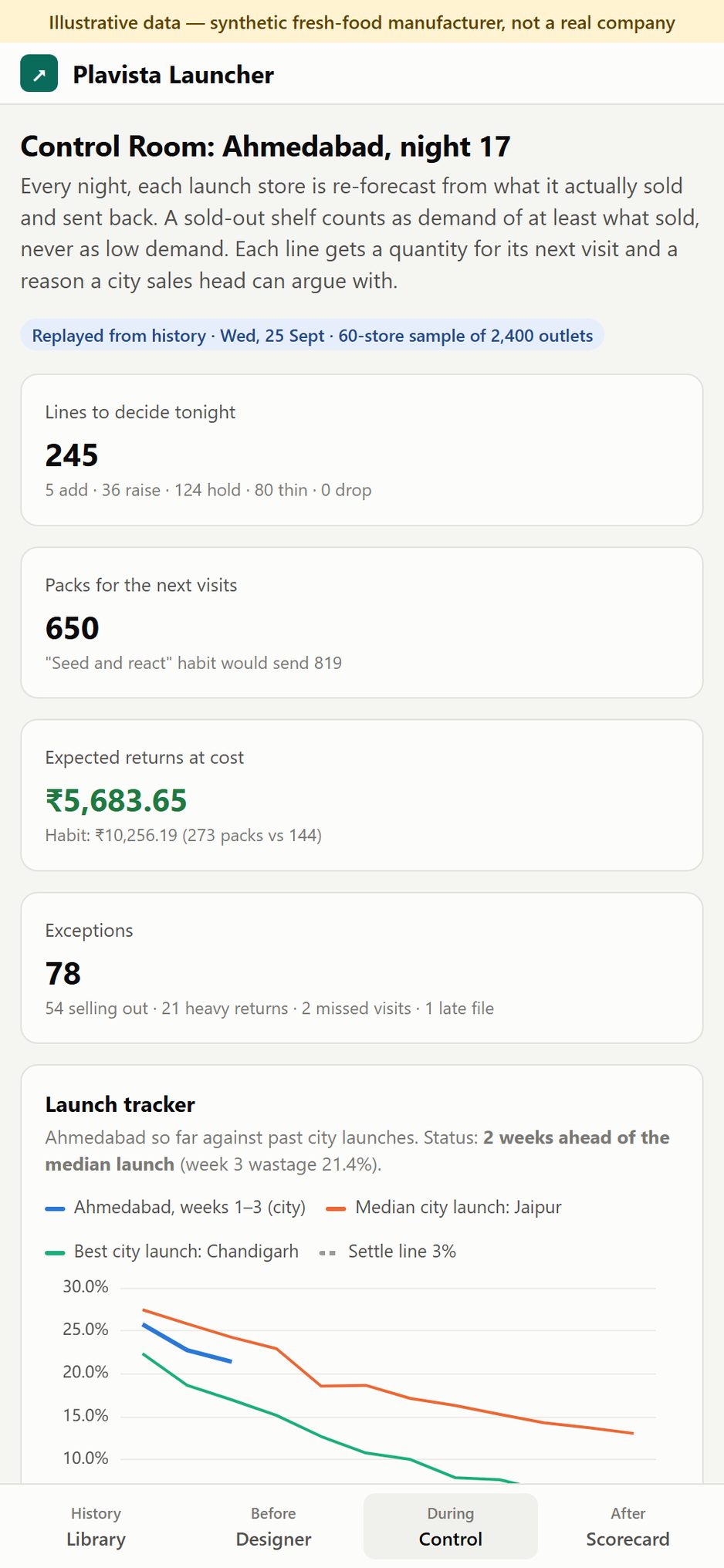
Every night, each launch store is re-forecast from what sold and came back, with a call and its reasons: add, raise, hold, thin or drop. An early read says which stores and tiers are tracking above or below the analogues. Changes need a reason code and are logged.
Launch Scorecard
At weeks 8, 13 and 26: what the launch cost against its plan and against the path of your median launch, in rupees at cost, the business case as it actually came out, and the decisions taken along the way.
The Control Room on a sales head's phone. The Library and the plan at head office.
Models built for launches, not a reused ordering forecast.
It starts from the right past launches
Each past launch is described by region, the size of its outlet universe, city tier, the region's affinity for the category and the launch season. The closest ones form the starting plan, weighted by how similar they are, and the screen says why each was chosen.
It learns each store from its own visits
A new store starts from what similar stores sold, worth only a few days of evidence, and its own sales take over visit by visit. A visit that sold out counts as demand of at least what sold, never as low demand.
It sends what the economics justify
The quantity balances a missed sale against a pack that comes back, over the days until the next van visit. For a product whose returned pack costs about what a sale earns, that is close to the middle of likely demand, not "never run out". Display minimum, trays and shelf life are applied and shown.
It knows when to let go
A store and product leave launch mode when four weeks of waste fall below the line you set, or at week 26, and go back to your own forecast.
The people who decide what goes into stores you don't own.
Heads of expansion and new markets
Plan each launch from evidence, pick the analogues, choose how widely to seed, and see how the launch is tracking against your best one.
Demand planners and city sales heads
Nightly store-level calls during the launch window, each with its reasons. Accept or change them, and feed back what the stores are really doing.
Supply chain
The launch plan by store tier and week, with likely ranges, before the first van leaves.
Finance and the business head
Waste above target valued at what it cost to make and move, the launch business case against what actually happened, and a record of each scale, hold or withdraw decision.
It does not replace the forecast you already trust.
For established stores and products, your own forecast keeps running exactly as today. Plavista Launcher acts only on stores and products in their launch phase and then hands each one back. It is designed to read your exports and return a file of recommended quantities with their reasons; it does not write into your ERP, distributor or route systems.
It shares Plavista's planning foundation with Plavista Fresh: the same way of reading store, item and day data, of treating a sold-out day as hidden demand, of valuing waste at cost and of explaining every number. The forecasting and decision models are its own, because planning a launch is a different decision from ordering tomorrow's fresh.