Fresh orders that sell before they spoil.
Plavista Fresh plans tomorrow's fruit, vegetable, dairy and bakery order for every store in your chain, overnight. Each line comes with its reasons. A store in-charge approves it on a phone in minutes, or head office approves it centrally. It works alongside the ERP you already run.
Fresh loses money twice, and most reports only show it once.
What you throw away
Every crate of tomatoes or tray of bread that expires on the shelf is cash written off. In fresh, a few days of over-ordering is enough. Over-order a biscuit and you tie up cash; over-order spinach and you lose it.
What you never got to sell
When milk runs out at 5:40 pm, the till records what sold, not what customers wanted. The next order is built on that lower number, so the shelf empties earlier again. The lost sale never appears on any report.
Store teams make these calls every night, for every item, in a few minutes before the cut-off, usually from memory. Plavista Fresh does that arithmetic for them and shows its working.
One engine, one screen for each person who touches the order.
Store in-charges
Tomorrow's order is ready on the phone by evening, with the biggest lines first. Each line says what to expect, what a busy day looks like and what is already in stock. Approve the lot in one tap, or change a line with a reason. Store screens are in English and Telugu (draft translation, under review).
Category managers
Waste and empty shelves for every store and category, against stores of the same size. A short list of the stores that need a call today, and why. One dial per category to set how much availability you want and what it will cost in waste.
Fresh heads and DC planners
Central ordering where you want it: head office approves, stores flag problems. A collection-centre buying plan rounded to whole crates. When the DC is short, stock is shared so every store ends with about the same days of cover.
Finance
Waste valued at what it cost you, never at selling price. Lost sales valued at margin. A write-off check that reconciles what Plavista Fresh measures with the "inventory written off" line in your audited accounts.
Statistical forecasting, corrected for the things that make fresh different.
It counts the customers you missed
On a day the shelf emptied, it estimates real demand from the time the last item sold: 82 packets gone by 5:40 pm, when a normal day has done 69% of its milk sales, means about 119 were wanted. When the time isn't known, a statistical method fills the gap.
It knows an Indian calendar
Weekday patterns, salary week in the first seven days of the month, and regional festivals such as Diwali, Dussehra, Ganesh Chaturthi and Bonalu, each with its own effect by category. Promotion days are kept out of normal demand.
It never orders more than can sell
Every order is capped at what can realistically sell before it expires, whatever else the arithmetic says. It rounds to your crates, cases or 0.5 kg steps, and keeps the display minimum on the shelf.
It explains every line
Each suggested line shows its reasons and every rule that changed the number: display minimum, crate size, shelf-life cap. Every change a person makes is logged with who, when, from what, to what, and why.
On the store phone at 9:45 pm. At head office the next morning.
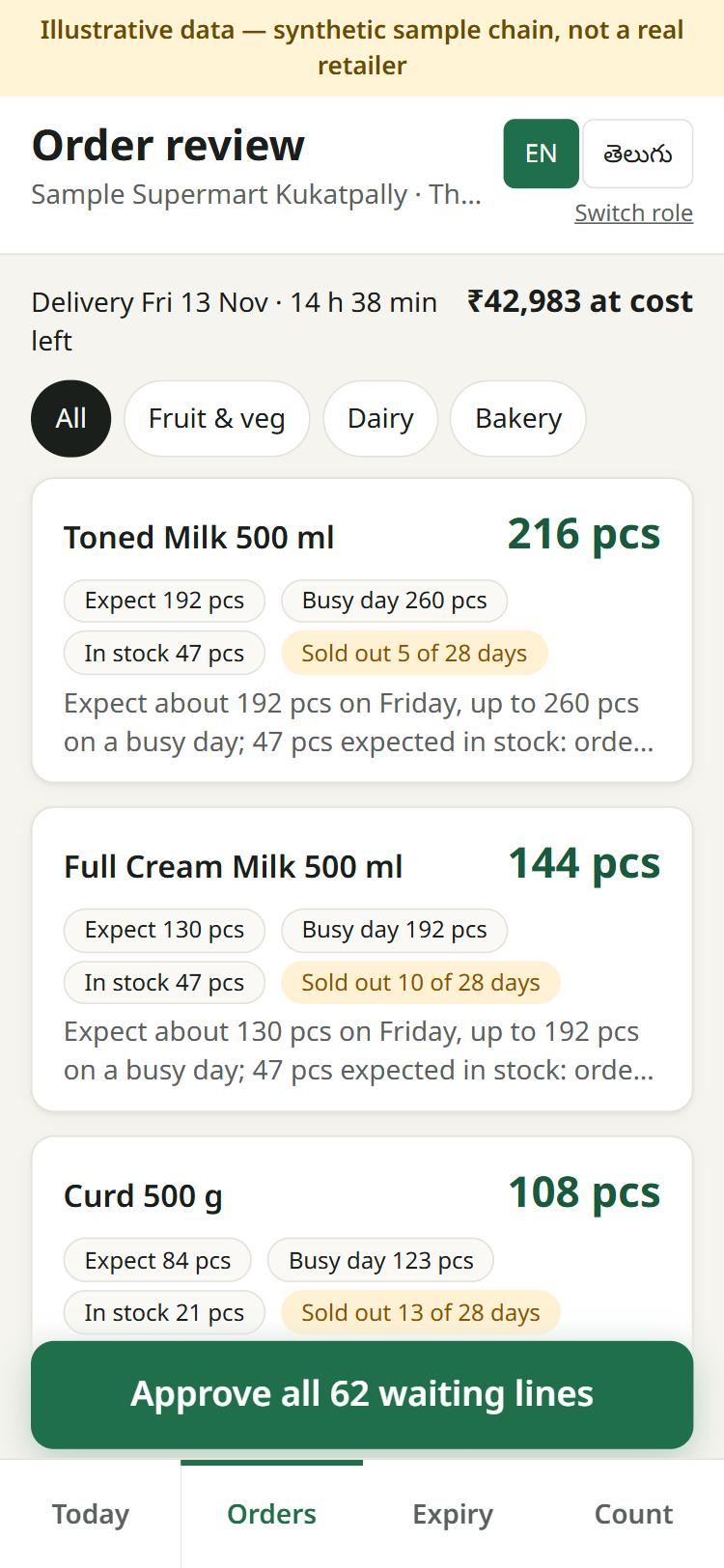
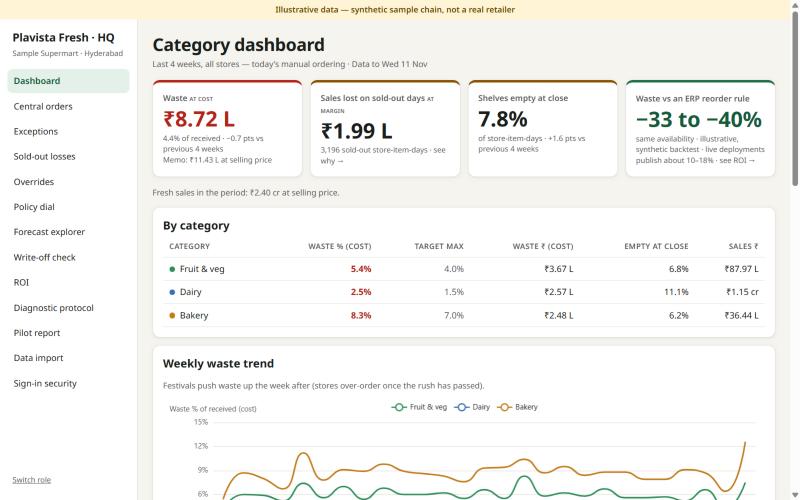
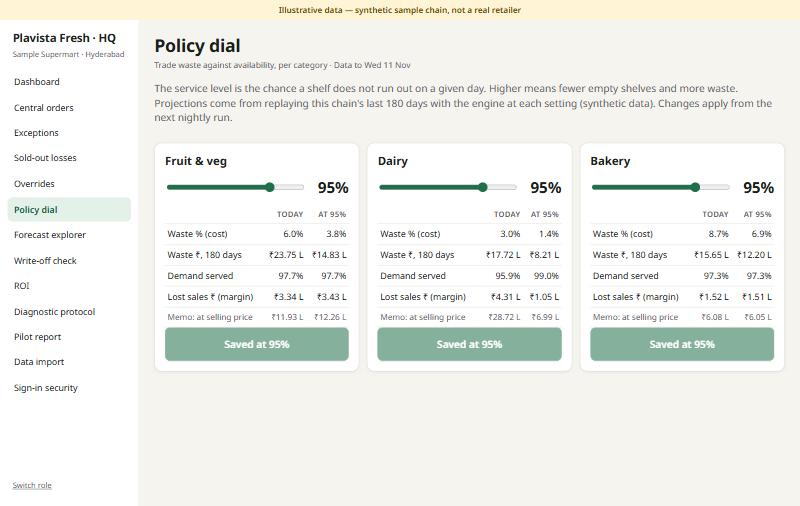
Less waste and fuller shelves at the same time, measured in rupees.
Most ordering tools make you choose: order more and waste more, or order less and run out. Plavista Fresh moves both at once because it corrects for hidden demand and for shelf life together, and it lets you set the balance per category.
Less modelled waste at cost than a well-tuned ERP reorder rule, at the same availability, across eight simulated 25-store chains.
Illustrative, synthetic backtest BT-2026-11-13. Not a client result.Share of customer demand served, against simulated manual ordering in the same test.
Illustrative, synthetic backtest BT-2026-11-13. Not a client result.Less waste: the range published from live deployments of fresh-ordering software in real stores.
PCFWC 2022; Afresh at Cub 2022; RELEX at BoothsThe simulation shows the method, not your result. Real stores are messier, which is why we start by measuring your own number, on your own data, against your own reorder rule.
No rip-and-replace.
You send an export
Store-item sales, stock, receipts and write-offs from your ERP or POS, as a standard CSV or Excel file. No customer data is needed.
Orders are proposed
Every fresh item in every store, with reasons, ready to approve on a phone or at head office before the cut-off.
Approved orders go back
An order file for your ERP, a collection-centre buying plan and purchase orders for suppliers who deliver direct to stores.
You see what it was worth
Waste at cost, lost sales and empty shelves, against comparable stores still ordering the old way.
Designed to read standard exports from common Indian retail ERPs. Live connectors are in development. Plavista is not affiliated with any ERP vendor.
Measure it on your data before you decide.
The diagnostic: where the money goes, plus a backtest on up to twelve months of your own history: Plavista Fresh against your ERP's current reorder rule and your actual orders, on the same demand.
Festival weeks, salary weeks and promotion days reported separately.
Three to four weeks side by side in a few stores, against matched control stores that keep ordering as they do today.
With a stop rule agreed in advance: if availability slips, that category goes back to your ERP rule.
A report of waste at cost, lost sales and availability for both, reconciled to your write-off line.
Including any case where Plavista Fresh did worse. The method is signed before your data arrives.
What retailers usually ask first.
Do we have to change our ERP?
No. Plavista Fresh sits beside it. It reads a nightly export and returns an order file your ERP can take in. Billing, purchasing, GRN and accounts stay exactly where they are.
Isn't this just an average of past sales?
It is an average with four corrections: sold-out days estimated from when they ran out, weekday, salary-week and festival effects removed, recent days given more weight, and the order sized for a busy day rather than an average one. Each correction shows in the reason on the line.
What if the store knows better?
Then the store changes the line. The screen shows the effect before saving, a reason is required, and the change is logged. Head office sees override patterns by store and category, never by person, so a dial set too low gets noticed and fixed.
We don't record when items sell out.
Your POS does: every bill has a time. If it can only export daily totals, Plavista Fresh uses a statistical estimate instead and still recovers most of the hidden demand.
Is our data safe?
We work with store, item and day figures only: no customer data, and staff names and phone numbers are dropped before anything is read. Data is hosted in an India cloud region, covered by an NDA and a data-sharing agreement, and deleted at the end of the diagnostic. Head-office access uses two-step sign-in.
What does it cost?
Pricing is per store per month, quoted once the diagnostic has measured your saving, so the price is set against rupees you can see.
Which languages do the store screens use?
English and Telugu today (the Telugu is a draft translation under review). Kannada, Tamil, Hindi and Marathi are planned.